
Microsoft continues to build its suite of Learning Accelerators to support teaching and learning with their new feature Maths Progress. Maths Progress allows teachers to generate a series of maths questions and create their own, making it a valuable tool for colleagues across Edinburgh schools. You can watch our video series exploring the Maths Progress feature here.
Generating Questions
Using Maths Progress, teachers can craft their own numeracy and mathematics questions on a variety of topics. Questions can be generated based on prompts in categories i.e. fractions and number operations. In addition, they can create their own questions, and Maths Progress can also generate sample answers to reduce workload.

Question Types
Currently, there are four categories available for educators to choose. These can be focussed further.
| Category | Sub-focus |
| Number and Operations | Addition and subtraction Multiplication and division Mixed operations with numbers Factoring numbers Operations with decimals |
| Fractions | Basic operations with fractions Mixed operations with fractions |
| Expressions and Equations | Linear equations Equations with absolute values Quadratic equations Linear inequalities Quadratic inequalities Polynomial factorization |
| Algebra | Logarithmic and exponential equations Polynomial equations Power and roots |
Pupil Evaluations and Evidence
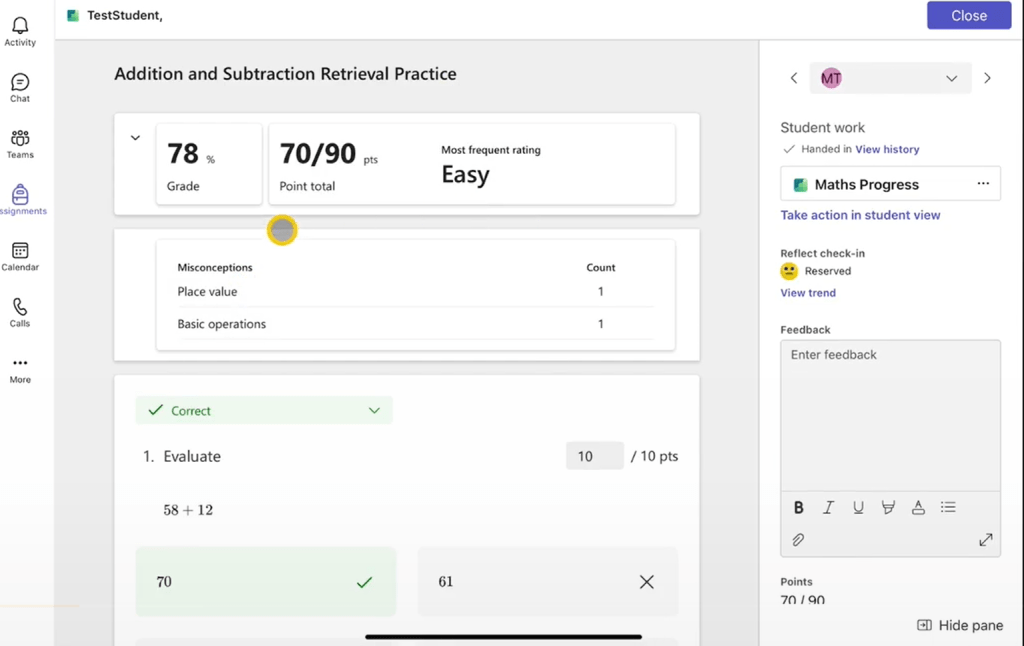
Learners have the option to score questions based on their thoughts on the level of challenge provided. This is a useful feature for educators in order to ensure they are meeting the needs of all learners, whether through support or challenge. Learners are also asked to submit evidence of their working-out of questions – this can be shown as photo evidence or a screenshot of work from a Class Notebook.

Assessment
The streamlined assessment feature allows educators to quickly access student results whilst identifying trends in the student’s learning. Educators can explore whole-class insights using the Insights feature in Class Teams pages.
You can watch our video series exploring the Maths Progress feature here.
 Edinburgh Learns Digital | City of Edinburgh Council