
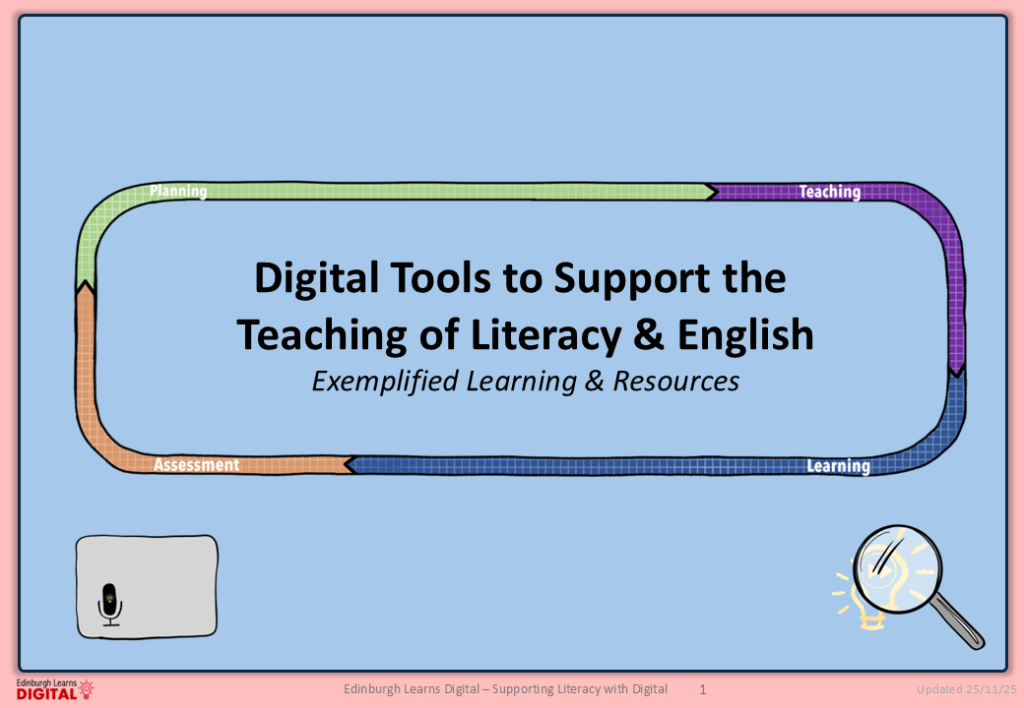
The use of digital tools can transform the teaching of literacy. This document is intended to support staff with practical teaching ideas to integrate digital tools into the teaching of reading, writing, and listening and talking.
Download the document here or click the image.
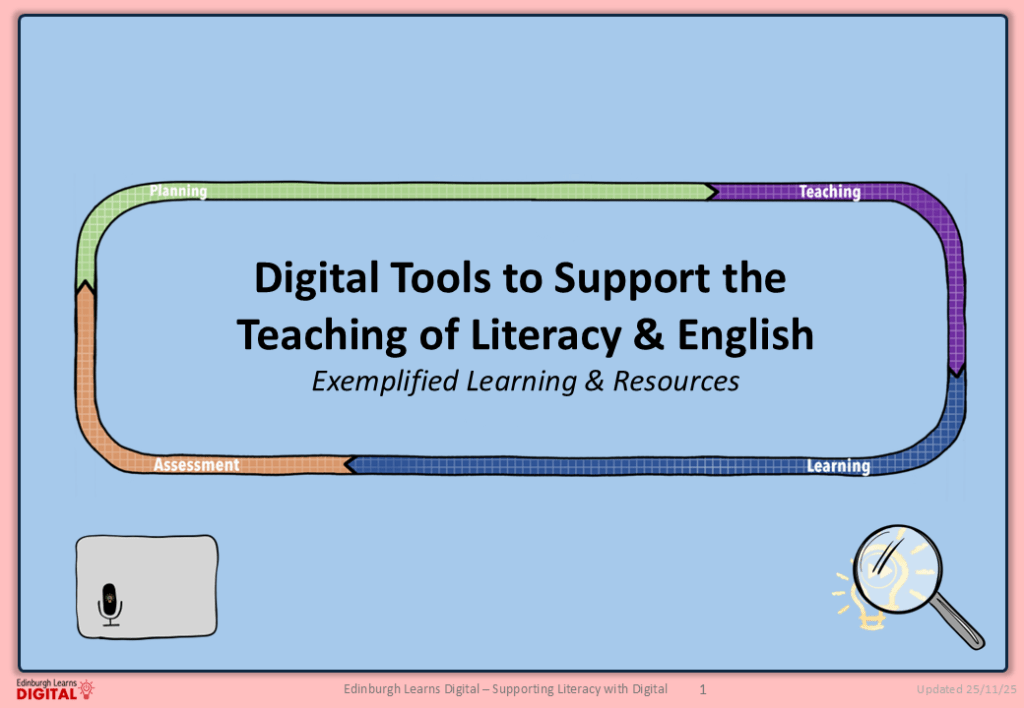
Tools to Support
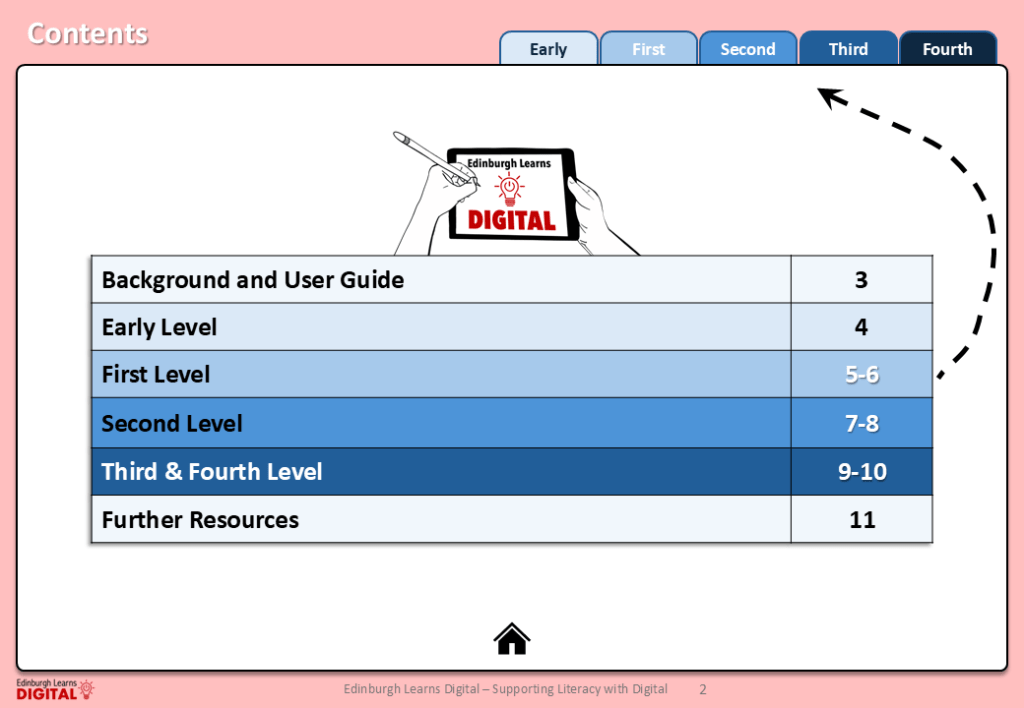
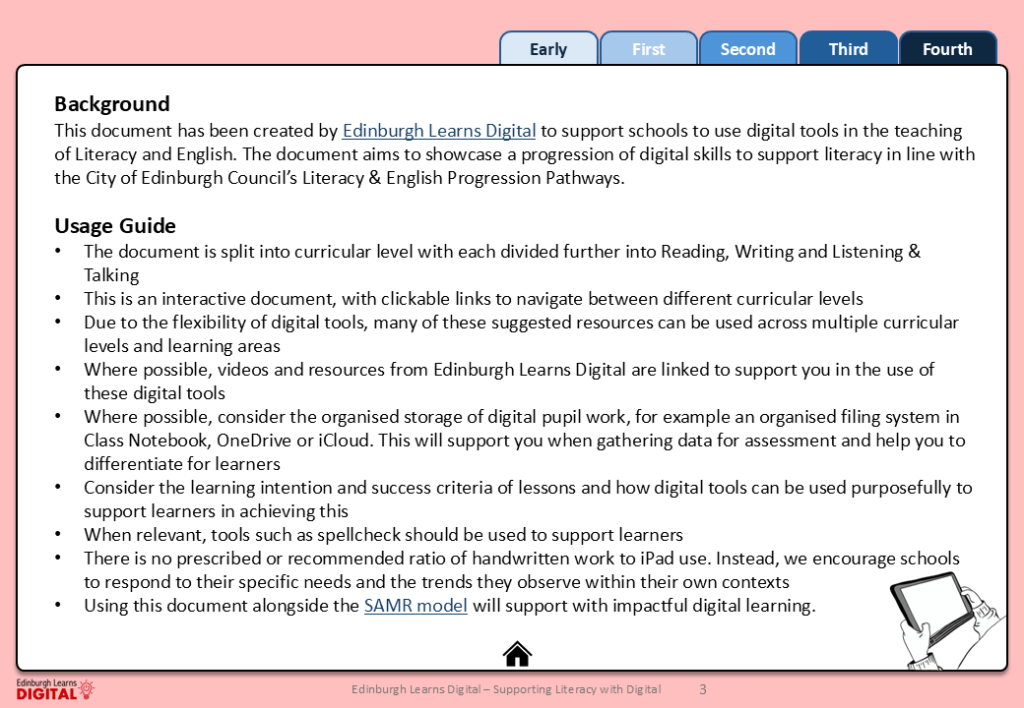
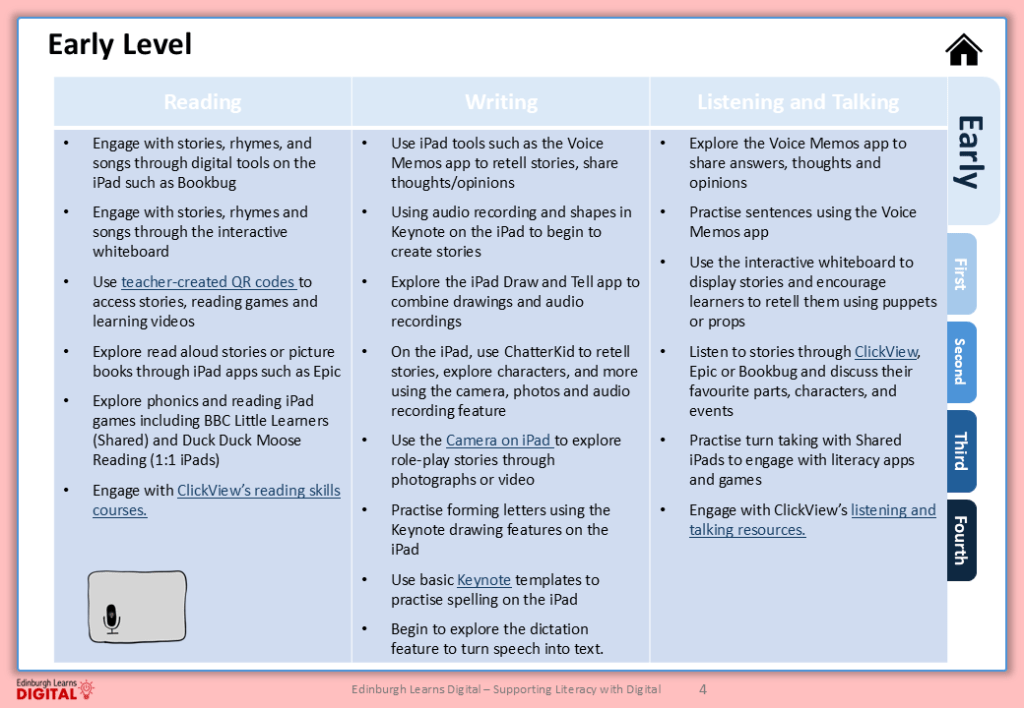
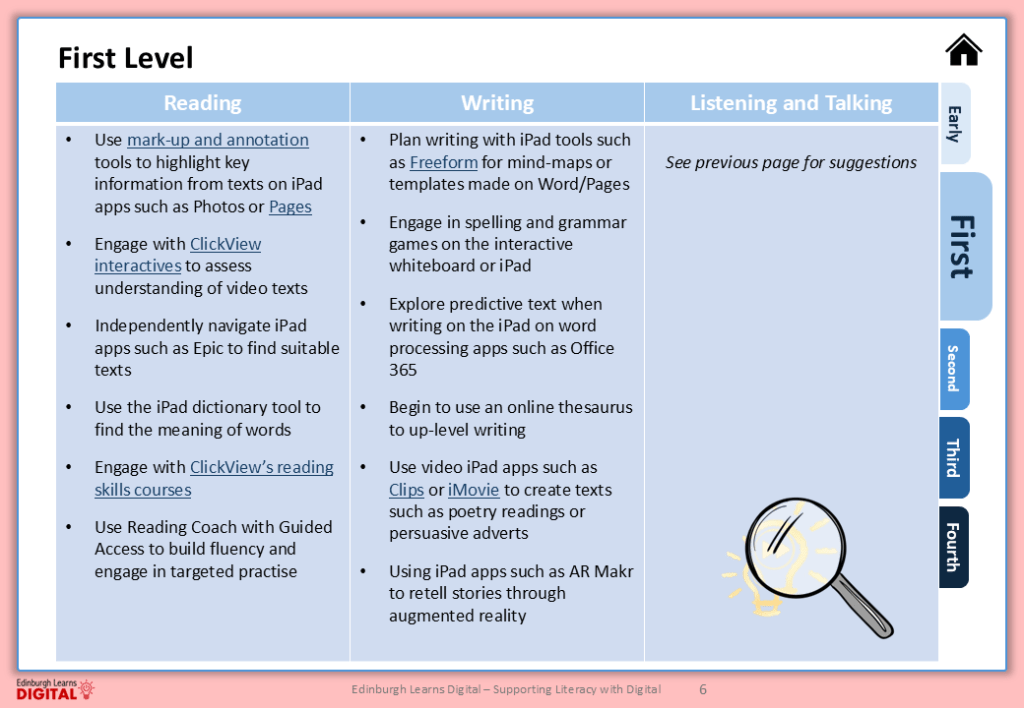
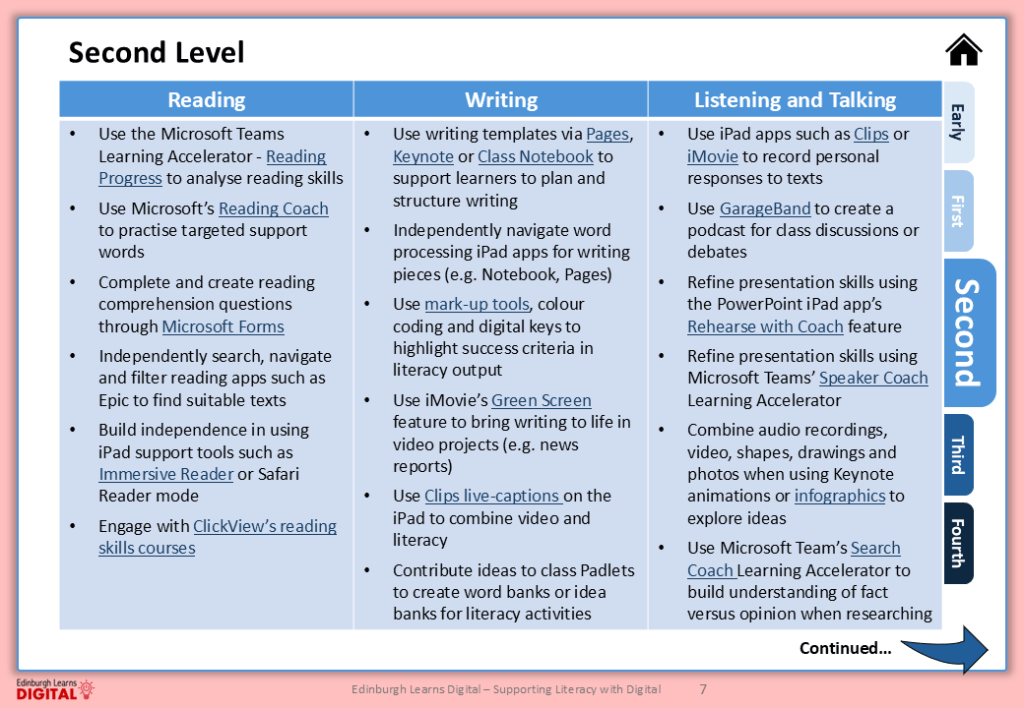
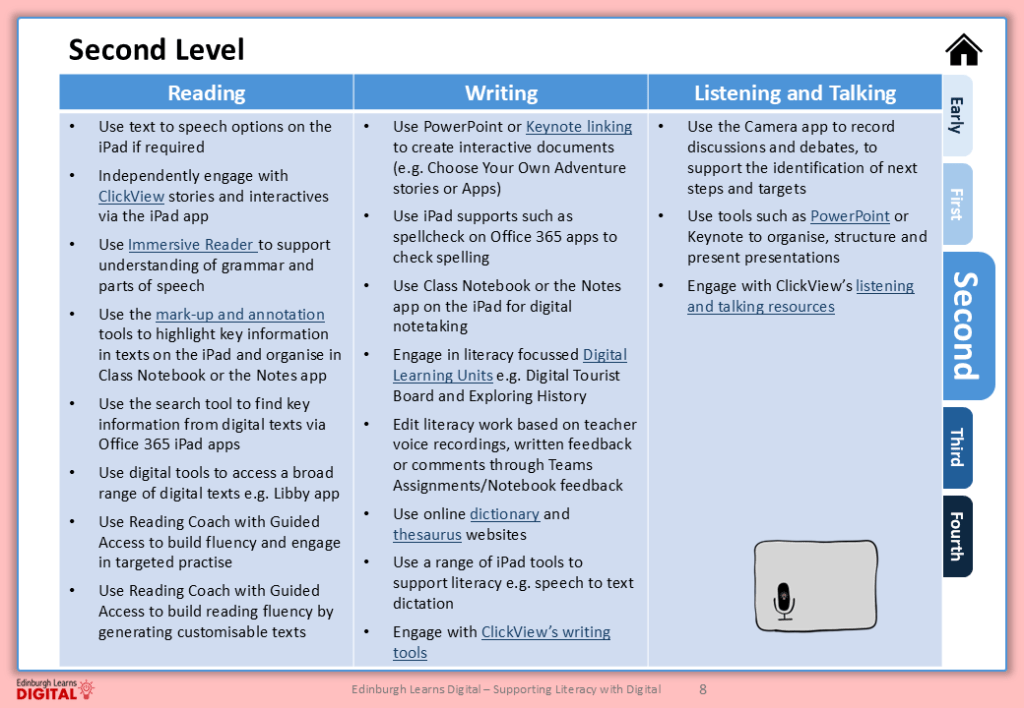
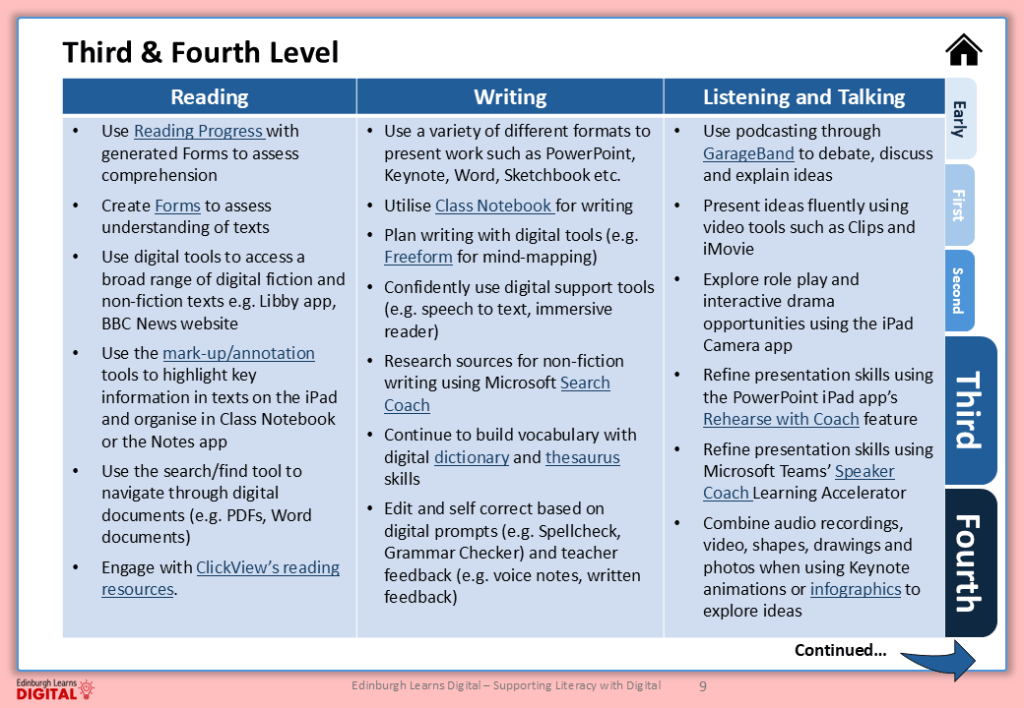
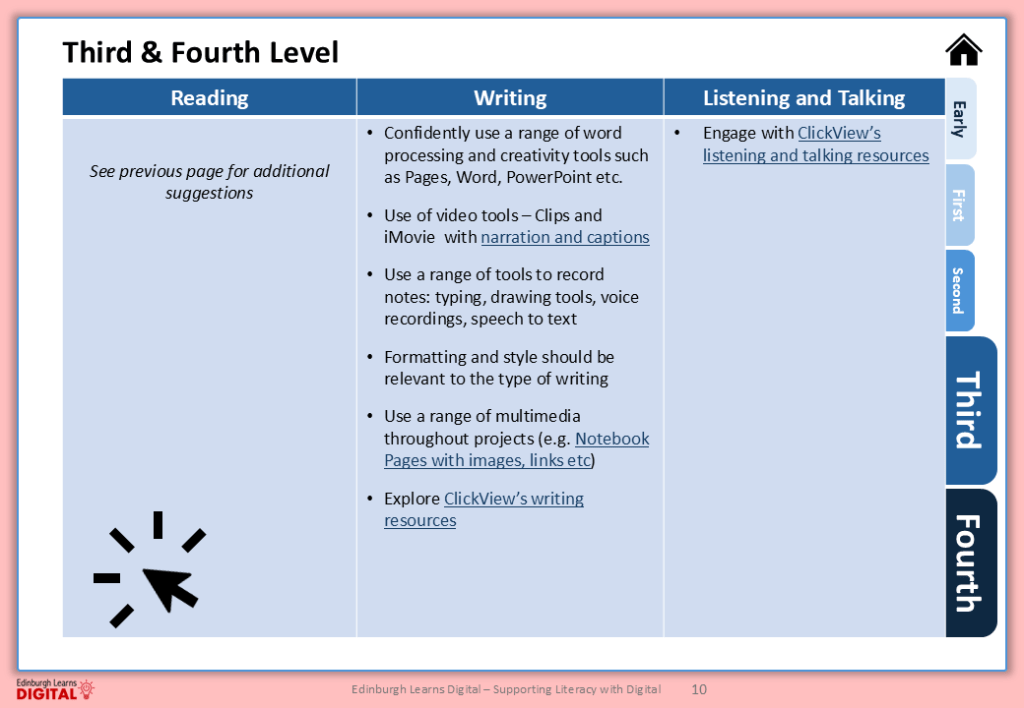
Below you will find a selection of suggested ways in which digital tools can be used to support the development of writing, reading, and listening and talking skills. Click the drop down arrows to expand the sections. Exemplified learning and resources are also found in the full Digital Tools to Support the Teaching of Literacy & English document.
Writing
As well as digital accessibility tools to support inclusion, technology can encourage learners’ motivation to write, their confidence in writing, and enhance their creativity through developing literacy skills in a range of mediums.
Apps aimed at early learners (including ChatterKid and Draw and Tell) can utilise audio features to support the development of learner ideas, with iPad drawing tools allowing letter formation to be practised. An extensive collection of digital activities to practise and reinforce spelling and grammar rules can also be utilised. Digital tools encourage the planning, organisation, and structuring of writing (e.g. mind-mapping in Freeform and writing templates in Pages or Keynote). Digital word processing tools (including Pages and the Office 365 suite) can support learners in the planning, structuring, editing and presentation of their writing work with an extensive collection of tools to encourage them to enhance their texts (including built-in dictionaries, thesauruses and the speech-to-text feature).
Writing can be transformed utilising video and filmmaking tools such as iMovie and Clips, allowing learners to redefine tasks, utilise their writing skills in practice, and showcase their understanding of content through audio-visual methods. These can be planned in a manner that allows digital collaboration between learners (e.g. texts accessed from a Class Notebook or class Teams page).
Reading
Digital technology can support learners in developing fundamental reading skills including vocabulary, fluency and comprehension.
As well as providing an expansive wealth of texts for learners to read (with apps including Bookbug and Libby), digital tools such as Microsoft’s Reading Progress encourage both teacher-driven and self-directed assessment of student reading skills, evaluating their fluency, expression, and understanding. Targeted guidance can be provided to learners via Microsoft’s Reading Coach which supports with differentiated challenge. Younger learners benefit from apps including BBC Little Learners and Duck Duck Moose Reading to build phonological awareness and decoding skills.
Digital tools including Microsoft Forms can utilise responsive and customisable ways in which learners can share their understanding of texts. Built-in iPad tools such as the dictionary, mark-up feature, and search function allow learners to navigate to information and build their note-taking and vocabulary skills.
Listening and Talking
Digital tools can further develop learners’ skills and abilities in listening and talking. These can aid learners in the development of skills centred around communicating ideas, finding and using information, establishing the tools for listening and talking, and for understanding, analysing and evaluating.
Younger learners can communicate ideas using audio and video recording apps, whilst all benefit from engaging with their learning through voice memos. Learners can engage through audio and video content on platforms such as ClickView and Bookbug. Tools such as GarageBand allow learners to collaboratively debate, discuss, and critically engage with ideas, whilst Clips is a useful means of recording short-form videos expressing ideas and creative thinking.
Learners have access to PowerPoint and Keynote, powerful collaborative tools for them to communicate and share their ideas. Self-reflection and targeted support can be provided through PowerPoint’s Rehearse with Coach feature, which allows learners to identify specific targets in the sharing of ideas. Aligning with the cross-curricular teaching of digital literacy, learners can utilise tools such as Microsoft Search Coach to allow them to critically analyse the reliability of the sources that underpin their research.

Accessibility
An extensive selection of accessibility tools are available on the iPads to support learners to access their learning – these can be particularly useful in supporting the development of literacy skills.
Below you will find a selection of suggested ways in which digital tools can be used to support develop writing, reading, and listening and talking skills.
Research
This range of research articles explore the links between digital technology and the development of skills in reading, writing, and listening and talking.
| “Most teachers felt that digital technologies helped shape student writing and saw clear benefits, like the possibility of sharing work with others. This resulted in greater collaboration and more creativity and personal expression. Teachers felt digital tools encouraged students to invest more in their writing and they made teaching writing easier.” | “The Impact of Digital Tools on Student Writing and How Writing is Taught in Schools” Pew Research Center (2013) Cited here. |
| “Computer-based teaching tools could be used in learning settings to promote individualized learning, with tasks being adapted to each child’s learning progress to provide responsive and immediate feedback on exercises and to potentially increase the student’s motivation.” | “Reading and Writing Development in Inclusive Settings…” Lyytinen et al. (2007), as cited in D’Anna et al. (2025) Read here. |
| “The research further indicated a significant enhancement in students’ writing abilities after using digital writing tools. Additionally, students perceived that the improvements in their writing proficiency were due to the supportive guidance and real-time feedback provided by these digital writing tools.” | “Exploring the effectiveness of digital writing tools on Thai EFL students’ writing” Pitukwong & Saraiwang (2024) Read here. |
| “Reading comprehension was significantly higher for the TTS (text-to-speech) versus No TTS condition. … TTS is a useful compensatory reading aid for improving comprehension.” | “Enhancing Reading Comprehension for Students with Text-to-Speech (TTS)” Keelor et al. (2020) Read here. |
| “Assistive reading and writing applications were perceived to function with regard to students’ possibilities to … access texts, reduce writing load, and support reading and writing processes.” | “Assistive technology applications for students with reading and writing difficulties” Nordström et al. (2019) Read here. |
| “Digital tools can help writers in all stages of the writing process, as they brainstorm, research, take notes, outline or map, draft, cite, rewrite and revise, add graphic elements, edit, share with colleagues and finally submit their manuscript…” | “Digital Tools in Academic Writing?“ Al-Jarf (2018) Read here. |
| “Technology offers new possibilities for accessing information, writing, and collaborating with others…” | “Investigating the Opportunities for Digitalization in Academic Writing and Information Literacy Course” International Technology and Education Journal (2023) Read here. |
| [Digital tools] “enable students to annotate texts collaboratively, highlighting key passages, posing questions, and engaging in discussions directly within the digital text. Research suggests that annotation fosters deeper reading, improves comprehension, increase student motivation, and foster a sense of community…” | “Technology-Enhanced Academic Literacy…” McCullough (2022) Read here. |
| “A recent literature review… notes that ‘when e-books are properly selected and used, children develop literacy skills equally well and sometimes better than with print books.’“ | “The Impact of E-Book Reading on Young Children’s Emergent Literacy Skills: An Analytical Review“ International Journal of Environmental Research and Public Health; López-Escribano, Montesino, and García-Ortega (2021) Read here. |
| “Digital tools can assist students in navigating this complex terrain by providing access to disciplinary knowledge and writing support… Online resources like the Oxford English Dictionary, academic journals, magazines, and newspapers… offer full-text articles, sophisticated search functionalities, and citation management tools…” | “Technology-Enhanced Academic Literacy…” Trakhman, et al. (2025) Read here. |
Further Support
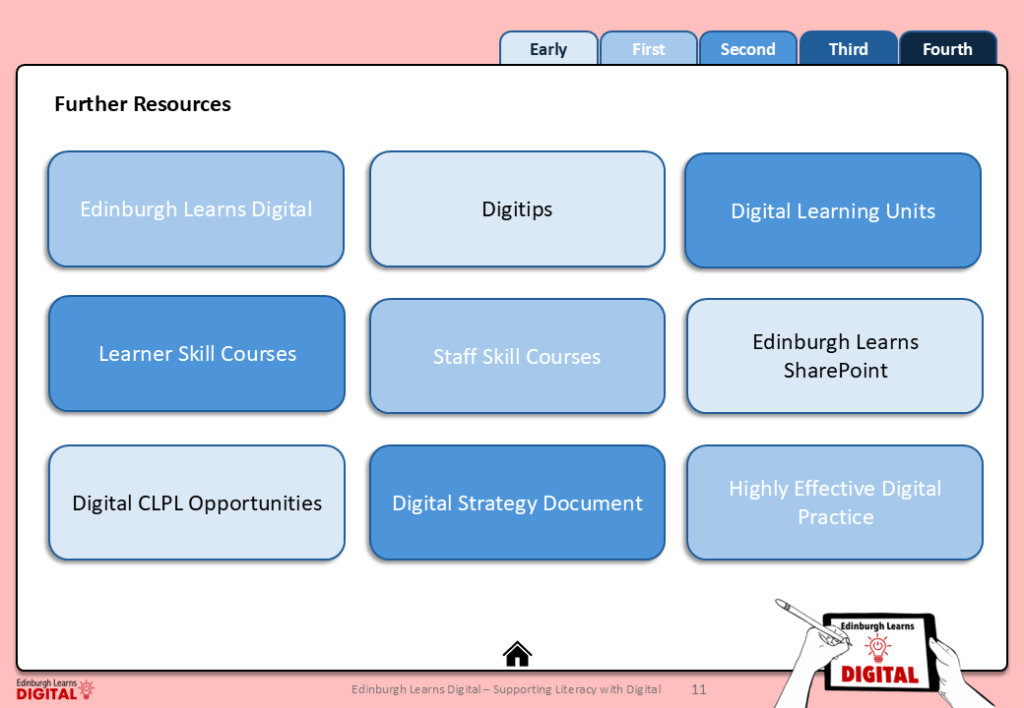
The below links may be helpful in exploring how to further develop the teaching of literacy in your classroom using digital tools.
 Edinburgh Learns Digital | City of Edinburgh Council